


Ranunculus and anemone: how to choose the right varieties
Ranunculus and anemone are a spring staple on our farm. Our spring bouquets would be rather hollow without them. Years ago, when I planted my first anemones, the flowers were desperately short and I could only use them in the smallest of bouquets. Why? I bought the bedding varieties which were not bred for cutting. After this experience and thanks to the blog and the amazing photos of Green and Gorgeous, I immersed myself in the world of cut flower anemones. Throughout the years, I studied and tested all that market has to offer in the world of cut flower anemone and ranunculus varieties. Check out the results of my studies in this blog – I hope it will help you choose the variety that suits you best.
Ranunculus or anemone?
Both of these species are important spring flowers in our garden and a staple of our bouquets throughout late spring and early summer. They share many similarities. Both are Mediterranean plants, they do best in the environment with mild winters without heavy frosts and a cooler spring climate. In order to bloom, they need several weeks of growth in cold weather. During this time, they form a rosette of leaves and as soon as the ground starts warming up a bit, they send out taller flowering stems with one or more buds. They continue to shoot up new buds until the weather gets too warm. That’s the signal for them to begin their summer dormancy. They stop blooming, withdraw energy from the leaves into the tubers and wait for the return of cooler weather in autumn / winter.
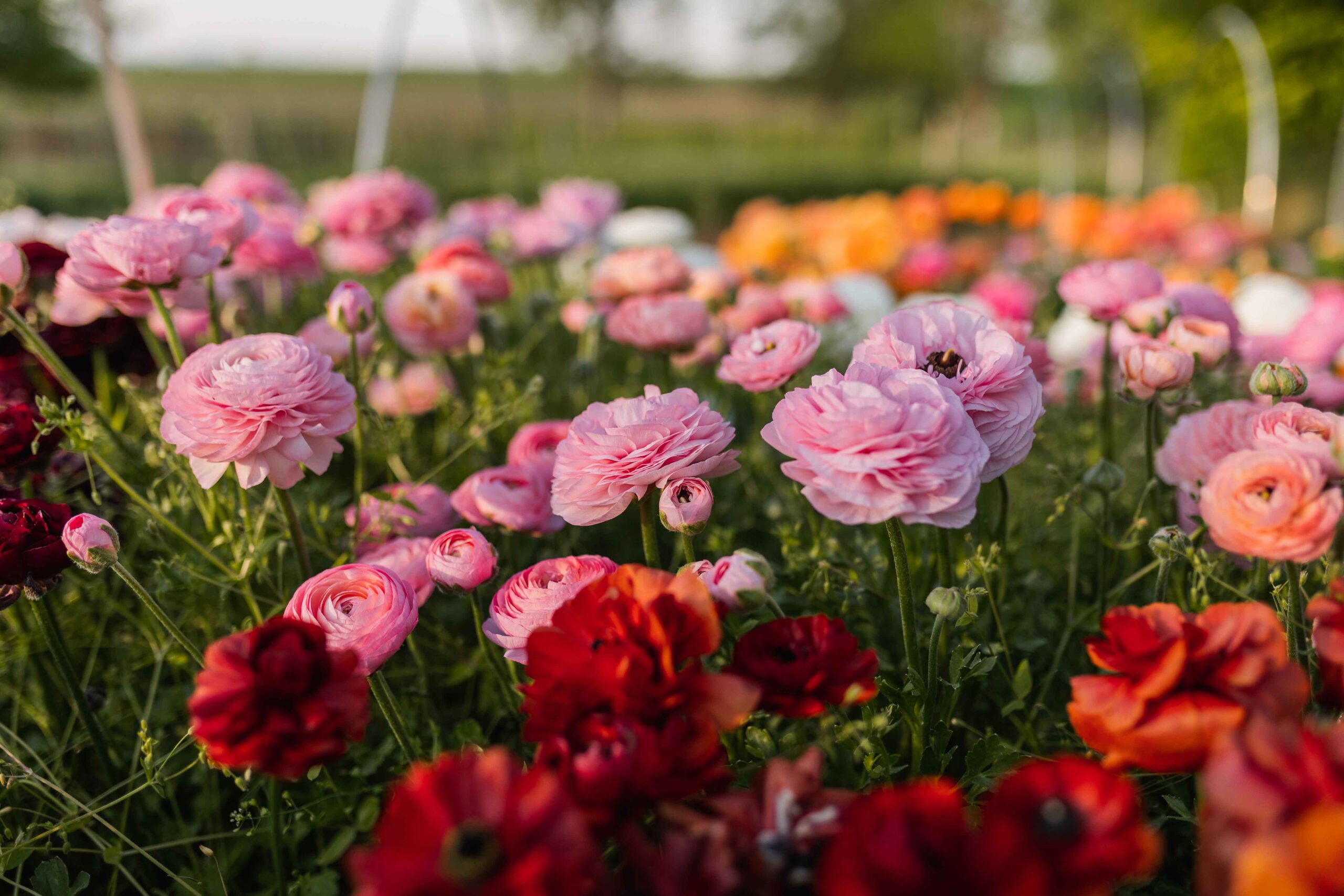
However, there are slight differences in their cultivation and use in floristry. Ranunculus (or persian buttercup) flowers are usually rather large, double, expressive and delicate at the same time. Their color palette covers warm tones, ranging from white to cream, shades of yellow and orange, plenty of roses and pinks, right up to reds and burgundies. Compared to anemones, they are more sensitive to frost, so they overwinter (at least in our climate, zone 6b / 7a) only with frost cover (greenhouse, low tunnel). They should overwinter without cover in zones 8 and higher. On the other hand, they handle warm weather better and you can plant them in spring in many places. In my experience, they are more fickle than anemones, so I wouldn’t recommend them to complete beginners.
Anemone flowers are mostly single (although recently several breeders have also bred beautiful double flowered varieties). They often have a pronounced, dark center and add drama rather than tenderness to the bouquets. My customers often mistake them for poppies and that’s what makes them popular. They are more frost resistant and generally a bit more viable than ranunculus, so I would recommend them even to beginners. Some varieties bloom super early, depending, of course, on the weather. We had years when they started blooming as early as in February, outpacing even daffodils and tulips. On the other hand, compared to ranunculus, anemones are more sensitive to high spring temperatures. They need a long period of growth in cold temperatures in order to have high-quality flowers with long stems. Here in southern Slovakia, only the autumn planting has proven successful. However, in colder locations, planting in late winter / early spring can also work well.

Ranunculus varieties
Let’s jump right into the world of ranunculus varieties. All the lines and varieties in this blog are bred for cutting – to have the longest, strongest stems and to last in a vase as long as possible. If you want to use them in ornamental beds, they will certainly stand out beautifully there, too. Just make sure they are protected from strong wind so that the flower stems don’t break.
On our farm, I grow most of the lines described in this blog. They start flowering at different times and the first wave of flowering tends to produce the largest flowers. As we need a supply of large, spectacular flowers, we plant varieties from different lines. This way, the large first flowers don’t come all at the same time, but rather gradually. Moreover, each line has specific colors that we love and would not give up for the world :).
Elegance® line
Elegance® varieties are bred by Italian breeders from Biancheri Creazioni. For a couple of seasons, they have been the main group of ranunculus in our garden. Although the characteristics (such as flowering time, flower size and stem length) vary between individual varieties / colors, they generally bloom rather early, have large flowers, are productive and can handle higher temperatures in May and June quite well. The producer claims that they are suitable for various types of climate and growing techniques, so they should be able to handle the cold well, too. However, the winters in past years were so mild in our region, so it’s difficult for me to evaluate how they can handle more intense frost.
In mild climates, they can bloom after just eight weeks, but it can take them much longer in colder weather. In the first month of flowering, they will produce about four flowers per plant, but in the good season you can collect up to 12 flowers per plant in total. Just like other ranunculus varieties, the first flowers in the season are the largest and the flowers from the later stages of flowering tend to be smaller.
In our e-shop, you can find soft tones of white, cream, blush and rose, wonderfully warm salmon and coral, contrasted white picotee, as well as intense intense malva and yellow. We also offer several beautiful pastel colour mixes: Pastel, Champagne and Fresh Spring.


Cloni Success® Line
This exclusive line from Italian breeders from Biancheri Creazioni is the best you can find among ranunculus varieties for cutting. As world-renowned floral designer Rona Wheeldon writes, there are ranunculus and then there are Cloni ranunculus! This line has been bred to have significantly larger flowers than other varieties, so can perfectly fill in for the peonies or the roses in your bouquets and arrangements. Unlike other varieties, they are not propagated from seeds, but from tissue culture. Thanks to this, the flowers have a uniform size and colour, but this also significantly raises the price of the corms. On our farm, I used to struggle with the lack of large, expressive spring flowers, so the Clonis have their place in my garden in spite of their high price. One of my favorite varieties is Grand Pastel. Its flower size competes with peonies’ and it has a wonderful salmon colour, which is one of my favorites. Hanoi with its amazing blush colour is the most popular variety among florists and designers.
Unfortunately, we do not have the varieties of the Cloni Success® line available in our e-shop. In order to protect their breeding work, the producer only supplies them directly to growers in wholesale quantities (min. 500 pcs per variety). All Cloni ranunculus varieties are licensed and cannot be reproduced without the written consent of the license owner.


Cloni Pon-Pon® line
The next exclusive line from Biancheri Creazioni we have tested on our farm is Cloni Pon-Pon®. All the varieties in this line have large flowers of a very unusual structure: almost round, full of curly petals with a coloured outer part and a green center. They excel in vase life: when they are picked in full bloom, they can last up to three weeks in a vase with no change in their appearance. In addition, their full flowers with firm petals can handle the transport very well, so they are also very suitable for wholesale production.
Similar to Cloni Success®, they are propagated in vitro from tissue culture, so they have large, uniform flowers, but are much more expensive than other varieties. On our farm, we have tested the Malva variety and we love its standing out purple colour.
Cloni Moderna® line
In 2024, our Italian producer launched a new Cloni Moderna® line. I’d venture a guess that they react to the trend of designers favoring soft, single or semi-double flowers of Butterfly ranunculus, with a number of blooms on each stem. We have not tested these varieties yet, but hopefully will plant some of them next season. The varieties of Moderna are mostly of soft pastel colours, we love the soft pink of Riviera and the warm yellow-salmon of Miele variety.
Pauline and/or La Belle line
Moving on to the varieties supplied by our French producer, here comes Pauline line. Although I have not found this information explicitly written, I’m almost sure that the Pauline line is identical to the one called La Belle by the US growers and suppliers. Plenty of ranunculus flowers you see in the photos of US flower farmers belong to this line.
Paulines are always the first to bloom on our farm. This line has an excellent ability to cope with winter cold, but is also less resistant to high temperatures. Therefore, its blooming window is earlier than other ranunculus varieties. The flowers have a lower petal count than Elegance or Amandine line, so they aren’t so full and give a lovely delicate impression. When fully opened, the dark center of the flowers is revealed and their look resembles the poppies.
In our e-shop, this line is represented by wonderfully dramatic chocolate (this one is regularly the very first to bloom on our farm), warm salmon, distinctive lavender, and a Champagne mix full of warm pink, orange and coral shades.


Amandine line
Amandine line is close relative of Pauline and makes up the bigger part of the Floret Flowers selection. It’s bred to handle high spring and summer temperatures well. This means it is more sensitive to the cold. It begins to bloom later, but keeps forming new buds longer than Pauline, even after the onset of higher temperatures. Compared to Pauline, the flowers have higher petal count and seem more lush.
In our selection, you can find Amandines in white, soft pink Marshmallow, antique Purple Jean and our most favourite pink variety called Porcelaine. We also offer a couple of colour mixes: Pastel Lemon in soft yellow and orange tones, Wedding Pastel in blush, rose and cream tones and Pastel mix with a predominance of pink.


Reinette line
A very unusual looking variety that has distinctive curly flowers with colourful outer petals and a green center. The palette consists mostly of intense colours, adding drama and contrast rather than tenderness in bouquets and arrangements. The line is produced in white, yellow, orange, brick, red, pink and salmon colour. The mix of colours, which is available in our e-shop, also contains approximately 15% pure green flowers. The growth and resistance of this line are similar to Pauline, but Reinettes bloom a bit later.
Friandine line
This line is new to our farm and we will be testing it this year. The Friandine varieties should have large flowers and are especially good for winter production, if you have a heated greenhouse or tunnel. We are testing our favorite salmon colour this season. If Reinettes prove to be productive, we will add a beautiful, delicate lemon colour to our selection.

Japanese ranunculus
The Japanese varieties of ranunculus, bred by Aya Engei, belong to the most expensive ones, propagated by tissue culture. Their flowers do not have hollow stems, which makes them less susceptible to various infections. Unfortunately, these varieties are not included in our selection, as they have very strict copyright protection rules.
Butterfly® ranunculi have been particularly popular in floral design in recent years. They have delicate single to semi-double flowers with a darker center. The special feature is a large number (sometimes up to 12 flowers) on one stem. The varieties have interesting colours, with the petals darker in the centre and fading to softer shade outwards. Salmon-pink Musa and coral Eris are our favourites.
Romance® varieties are large, double-flowered ranunculi comparable to the Italian Cloni Success® and bred specifically for cutting. The flowers have long stems and last very well in a vase. Like Butterfly®, they have full stems and good disease resistance. From the wide range of colours, the blushy Plage and Maritime or the coral Nohant are our preferred varieties.
Anemone varieties
When growing anemones, selecting the right cut flower variety is even more important than when growing ranunculus. If you plant the common bedding variety (like De Caen or Sylphide), the plants will never produce long stems usable in bouquets and arrangements. Most cut flower varieties are of Italian, Israeli and French origin.

Galilee line
Galilee is one of the lines bred in Israel and the main line grown on our farm. They have medium to big flowers and long, strong stems, but also relatively good resistance to frost and high temperatures. They grow outdoors well, even without frost protection. From a number of the Israeli and French varieties (Jerusalem, Meron, Carmel, Marianne), Galilee is the only one we included in our selection. In the eshop, you can find Galilees in white with a black centre (AKA “Panda”), Bordeaux and in a Pastel mix including white, red, coral, violet and blue. If you want to test all the available varieties, we also offer a mix of all colours.


Mistral®, Mistral Plus® and Levante® lines
We started growing anemones from Italian breeders from Biancheri Creazioni a couple of years ago. As the producer promises, they produce large flowers on strong, long stems. In addition, the recently introduced Levante line has beautiful double flowers. However, Italian anemones seem to be less sturdy and cold resistant than Galilees. The greenhouse suits them the best and when grown protected, they produce really large, beautiful flowers on long stems. We are very excited about the colour palette, which includes soft shades of blue, purple and pink. Our favorites include the pastel coloured Rarity and azure with flowers in pale blue to purple tones. This season, we have also added double flowered salmon rose anemones from the Levante® line in our selection.


That’s our research and experience with different varieties of ranunculus and anemone. We will update the text regularly and hopefully, it will help you when choosing the corms for your garden or farm. What is your experience with the varieties of ranunculus and anemones? Which ones do you prefer? Have you come across any other interesting varieties you would like to try?